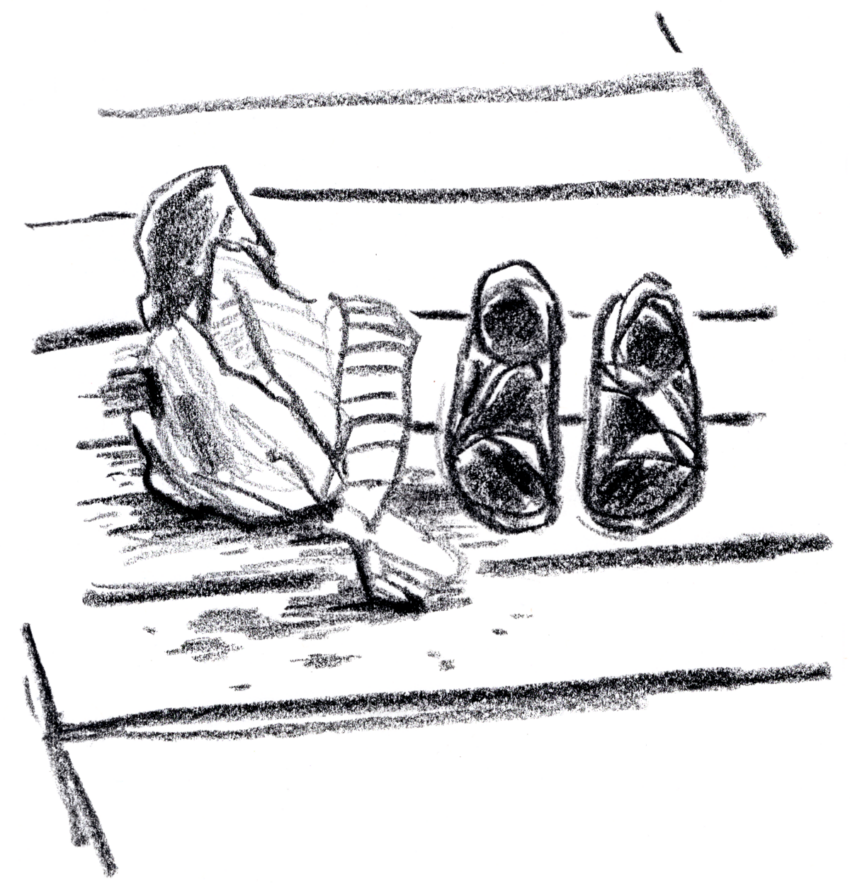
I jump into the water at the end of the dock and sink down, holding my nose. After the initial impact, I open my eyes, surrendering to the descent as it grows softer, and to the colors all around me that seem new, denser and iridescent. A minute or so passes. Finally, slowly, my feet touch the mossy ground, like I’m an astronaut landing on the moon.
I let go of my nose and lower my arms, and my body tenses up. My lungs contract, a spasm, and I wait. I touch the bag of rocks tied to my waist; I can always untie the knot. Instead, to keep from changing my mind, I inhale. Water fills my chest and a new, hard cold hits my ribs. A dozen bubbles escape from my mouth and nose and rise. Another spasm wracks me and I have a flash of alarm about what might come next. I let out my remaining air. I’m struck by a liquid feeling where there was oxygen, but I am lucid, calm.
I look at my hands, larger and whiter than they were above water, and wonder how long it will take to lose consciousness. I want this to happen painlessly. Algae, schools of silvery eyes, plankton floating like glitter. My body feels loose, and an extraordinary sensation arises from the contact with warm currents, cool ones, warm again. How much time has passed? Three minutes, five—I no longer know how to calculate. I was sure it would happen faster.
I touch the rope, feeling for the knot. I’m not changing my mind; at this point, what’s done is done. It’s curiosity. Then I untie the knot, and the rocks fall away. Their impact causes an earthquake near my feet, which lift off the lake floor. I stay there, floating, unsure what to do. And it’s then that I think, What if this is it? To float and wonder for the rest of eternity, unable to move in any direction ever again: the first real fear I have that day.
I kick against the ground to push upward. What went wrong? I’m trying to understand. For a moment, ascending seems easy, but after a few feet, my body stops, comfortable in its levitation. It takes a while to reach, finally, the crystalline warmth of the surface. Will I be able to breathe when I emerge from the water? I wonder if anyone is looking for me, and I worry about a possible scene. My arms take a few strokes, my head breaks past the water, and cool air rushes over my wet face.
If Blimp is an expert traveler in new lands, I am this woman anchored always to the same place.
The rocky shore is as empty as ever, and I paddle to the log ladder and climb onto the dock. I retch, leaning over, expecting to vomit up all the water, but nothing happens. The hot wood absorbs the drops falling from my chin. I try to stand but my body is weak and lax, so I wait a moment and try again. Across the garden, the sun bounces off the house’s windows and stings my eyes. I wring out my hair, the front of my shirt, the cuffs of my pants, and walk back down the dock. My sandals are still right where I left them. I slip them on and struggle up the embankment to cross the garden.
I remember how I reach the house. I look at my reflection in the glass of the back door, my wet clothes stuck to my body, my hand sliding open the glass that squeaks over the runner, taking my reflection with it. Then I see the living room, the dining-room table with the remains of breakfast still uncleared. I lean against the doorway and, with a final effort, cross the threshold.
Inside, everything is calm. The hydrangeas I cut earlier this morning are undisturbed in the two kitchen vases. I pick up the letters I’d left propped against them, the one I wrote for him and the one for the girls. I’m not sure whether picking up these letters is a good decision. I’m not even sure if taking them from this table means taking them from the same table where I left them not long ago. I’m not sure of anything, not then and not now, but the clock is already showing 12:20 p.m., so I go up to the bedroom, put the letters in the nightstand drawer, take off my sodden clothes and put on dry ones, and go down to make lunch.
They pull up honking the horn, and the girls roll into the house like a whirlwind. They’re carrying a big cage that holds a rabbit.
“We have to take care of it until Thursday,” my husband says. “One week per family.”
I’m beating eggs. It takes enormous effort, but I’m trembling, and I trust the action will hide my state. The girls wrap their arms around my waist, and I lift the bowl higher so I can see their faces.
“His name is Blimp.”
“Yeah! Blimp.”
Their voices echo in my head. The older one presses her nose into my stomach and inhales deeply.
“Mommy, you smell bad.”
The younger one copies her. “You do! Like dirty mud.”
“All right,” I tell them. “Let’s eat.”
I remember how afraid I am to stop beating the eggs. But I stop and nothing happens, no one looks at me. My older daughter pushes the cage against the wall and frees the rabbit. Her father hurries to close the sliding glass door. When he returns, he summons our attention with three claps of his hands.
“From now on, we keep all the doors closed,” he says.
I start the fifth omelet in the skillet and serve the ones that are ready. My husband knows he’s in charge of the one still on the burner, because he’s the only one who eats two. We sit down at the table, and the girls’ silence as they take the first bites helps me finally feel calm, at least for a few seconds.
Everything is in order, I tell myself. Easy now.
I sit watching the rabbit as, without any real caution or circumspection, it hops across the dining room and approaches its dish of water. If Blimp is an expert traveler in new lands, I am this woman anchored always to the same place. Blimp comes over and sniffs at my feet. His nose tickles, and to be on the safe side, I grab the edge of the table.
“His name’s Blimp ’cause he’s fat.”
“Nuh-uh, that’s not why.”
“Yeah it is, the teacher said so.”
The girls sword fight with their forks and then go on eating. My husband gets up for the last omelet, and on the way there, he’s already making a phone call.
Everything is in order, I tell myself, and the pleasure from the tickling nose surprises me.
“Mommy, are you happy?”
With her silverware held aloft, my youngest waits eagerly for my answer. Suddenly, she jumps down from her chair and runs around the table without ever lowering her knife and fork.
“Blimpy! Blimpy! Mommy’s happy!”
“But eating would be too much to ask, huh?” my husband says when he comes back with his second omelet, noticing the untouched food on my plate.
My oldest watches and listens. The worst part is whatever it is that she’s learning from us.
Lunch ends, and my family disappears up the stairs. I like this house because of its porous ability to absorb us all into its rooms. In the living room, the rabbit’s cage has been left open and empty, and I’m comforted by the thought of the girls playing with Blimp, entertained in my absence. It’s like when I can hear the washing machine or the microwave in the background—I relax because even if I can’t take action myself, something practical is still getting done.
I walk to the sliding glass door and gaze out at the garden. Everything that’s happening seems possible, but how can it be? How can it be that what happened, happened, and I still feel so fine, and even my hair is drying? I breathe, take my purse from the coatrack, and go out the front door. Once again, his car is parked diagonally in the driveway; it’s like a barricade. We don’t argue about that anymore. I’ve learned to slide between the front fender and the driveway wall almost without getting my clothes dirty. When he is home, going out is like “overcoming,” like “vanquishing” the entryway; if I want to get through it, I have to be determined.
He said it wearily, as if he’d been scrubbing at a stain for a long time and still couldn’t get it out.
The next-door neighbor is pulling up in his truck. This is the day I understand what it is he really does. But for now I just think he’s coming back from hunting, like all the days when he wears his cap with the visor forward. He has a pair of buckhorns hanging over the porch door, and though he’s not a military man, he dresses like one.
Three years ago, he was on the front page of the local paper for a harassment case brought by a woman who used to work at Toni’s café. After that article, we never saw her again. And then the thing with the barbed wire happened. We tried to talk to him the day he put it up, explaining several times that the girls could get hurt if they played too close to it. He said that was why the wire was barbed, that it was the only way parents would be sure to keep their children away.
“The wire is for the parents,” he said.
I remember how, during the course of this day, there are many things I try not to think about. At first, the neighbor is on that list.
Outside, in the shade of the trees, the heat is less stifling. On the corner, I ring Daniela’s doorbell and try to fix my appearance a little. I comb my fingers through the ends of my hair and find a piece of still-wet algae. It stretches out like gum when I tug at it. I drop it on the ground and wipe my hands on my pants, then ring the bell again. No one answers. When I get tired of waiting, I go down to the square.
The neighborhood still seems just as exaggeratedly big and moneyed as the day we arrived, several years ago now. A couple of blocks down is the café. Inside, two tables are occupied, and Toni is washing dishes in the kitchen. I see him through the little window, and he winks at me. I poke my head in and ask about Daniela, but he doesn’t know where she is, so I sit down for a minute at the counter. A while back, Toni and I had sex a few times, on the kitchen floor, in the changing room, and in the employees’ bathroom. And then one day, Toni said, “Okay, that’ll do it, right?” He said it wearily, as if he’d been scrubbing at a stain for a long time and still couldn’t get it out, and now he was finally giving up.
A woman comes over, picks up a sugar dispenser, and smiles at me before returning to her table. I touch my hair to be sure there is no more algae in it. I find a little strip, maybe a leftover bit of the other piece, but I don’t think anyone has noticed. I’m relieved to see that no one detects anything strange, and it makes me want to stand up and stretch my limbs, do something other than sit here waiting.
I go outside and smoke a cigarette. A car pulls in from the main entrance, passes the café, and drives off. The sidewalk has no columns or walls or posts to lean against—that’s what we have houses for. The street is just one long yard we can walk through. In the square, I sit down on the bench. I remember thinking that I’ll count to ten, and if I still feel like it, I’ll light another cigarette. I count so as not to think.
We can see the force in the tendons of his fist, the animal’s mouth stretched into a cruel smile.
Just then, I see the rabbit cross the street: a bunny fat enough to be named Blimp. He flees into the bushes. Then I see one of the girls. She is crying and clutching at her head, her face red and her nose running, the anguish so consuming her that the task of searching for the rabbit becomes impossible. Will she inherit my stunted emotional intelligence? The younger one trails her, copying her sister’s expressions but not crying, her attentive eyes peering into every corner. I stand up and walk toward them. Their father is trailing after them, phone dangling from his hand.
“You left the sliding door open,” he says.
“Mom! Blimp!”
The younger one hugs me. The older one cries. “What are we gonna do, Mommy?”
We split up, him with the younger girl, me with the older, one team on either side of the street, shaking bushes bordering the neighbors’ yards. Once, from the kitchen, I saw a couple of bums doing something similar in my own front yard. I don’t know what they were looking for. I called security, and someone came and took them away. But a woman’s yellow sweater was left hanging on the rosebush for almost a week. In the end, I picked it up and put it in the washing machine, by itself and on the fastest setting. I dried it, folded it, carried it the seven blocks to the bus stop, and left it there on the bench. I understood that wasn’t exactly the same as returning it, but at least I was putting it somewhere. I didn’t want things that didn’t belong to me in the house.
We move on to the next house’s yard. A neighbor peers out the window. I recognize her as the mother of the twins in my younger daughter’s class. She’ll come out and help us, I think. She’ll ask, “What happened?” And she’ll say, “I saw the bunny!” She peers at me and turns away from the window, and I look toward the door, expecting her to come out any second. But the door to her house doesn’t open.
Once, when I was late for pickup, she was there waiting in front of the school entrance, each of her hands holding one of my daughters’ own. She said to me, “This is the last time I’m waiting for you, understand? You’re not the only one making a big effort around here.”
My daughter catches up with me through the bushes and hugs me, and with her hug she also pushes me. We cross another yard. When her father gets tired of searching, he claps three times. The family gathers in the middle of the street, and we go back to the house. He is annoyed; I can tell by the tone of his voice.
“I know where we can get another rabbit,” he says.
He says it right in front of the girls, and suddenly four little hands clutch me tightly.
“No. No, no! Blimpy!”
We are at our driveway when, over my husband’s shoulder, I notice our neighbor walking toward us.
“Hello,” he says.
Only then does my husband turn and see the neighbor. He is carrying the rabbit by its ears.
“Is he dead, Mom? Mommy!”
The girls hop anxiously around us. The rabbit kicks the air and then surrenders again to the swaying.
“What if that hurts him?” my youngest asks.
“That’s how you carry rabbits,” my husband reassures them. But Blimp is too fat, and the man is close enough now that we can see the force in the tendons of his fist, the animal’s mouth stretched into a cruel smile, teeth sticking out, eyes narrowed and weepy.
“Who wants rabbit for dinner?” he asks. The girls scream. The man laughs.
“Here, take it. I come in peace.”
He holds the rabbit out toward us. My husband tries to receive it, phone still in hand, but can’t figure out how.
“You have to put the phone down to take the rabbit,” the man says.
I smile at his words, despite the distaste I feel for him. And when the rabbit finally changes hands, and the girls let go of me and run to their father, and he kneels down to reunite them with Blimp, the man turns to me, gazes at me for a moment, and frowns.
“What’s wrong?” He looks at my mouth, my eyes, my hair.
“It’s the girls’ rabbit,” I say. “Well, the school’s rabbit, and—”
“I mean with you. Are you okay?”
He takes a step toward me. I think of the algae and run a hand through my hair. I glance at my family to be sure that they’re walking away now.
“Nothing’s wrong,” I say. “It’s just that I saw you with the rabbit and it startled me. I know you like to hunt…”
“You think I hunt because I like it?”
He smiles, but he’s every bit as annoyed as my husband. He shakes his head slowly and never takes his eyes off of me.
“It’s really something to see you so self-righteous after what you did this morning.”
It’s as if he had grabbed me by the throat with both hands. As if now he were waiting, without ever loosening his grip. He saw me, I think. I remember how I can’t think about anything else, not about the rabbit or the girls or about what’s going to happen later. He takes another step toward me, and he’s too close now. His finger is pointing at the middle of my chest.
“You think you can do whatever you please and then just change your mind?” I glance around for my family, but they’re gone. “Do you really think that’s how it works?”
I take a step backward.
“Where are you going?”
I try to answer, but I can only step back again. “Hey! Wait, listen to me.”
I retreat another step, and another. I walk away, and every time I turn to look at him, he is still standing there, watching me. I walk fast, now without glancing back. I overcome the barricade, enter the house, close the door. Since this is my house, there are things here to lean on, columns and walls. I spend some time regaining my composure.
The sliding glass door is closed now, and the girls are playing, chasing after Blimp. Soon the house reabsorbs its inhabitants, releasing us in shifts and catching us again. After dinner, my husband goes into his study to work, and I put the girls to bed. It takes a while for them to calm down, and the youngest is the second to fall asleep. When she finally closes her eyes, I sit beside her for a while, looking at her. Then I focus on my feet: there is still dried, greenish mud between my toes. I take off my flip-flops and sniff them. I want to shower, get rid of this smell, put on my pajamas, and lie down, but I realize I’m not capable of doing any of that. Every time I think of the neighbor, my throat closes up again. Finally, I gather my strength and stand. I remember how I go down the stairs: telling myself, You have to move this leg, you have to move the other, reminding myself how to breathe, and, for the first time that day, a day I will never forget, giving myself an instruction.
He works in the bucket; there is blood between his fingers, on his wrists.
I leave the house again, maneuver past the car barricade to reach the street. The man is sitting on his porch steps. It’s the only fenced-in lot on the block, but when I get closer, I see that this time, the gate is ajar. I push it open and enter. He waits without moving as I approach. Two bright motion-activated lights come on and illuminate the yard. At his feet there are three buckets, dirty rags, some tools, and a pack of beer. A few seconds later, the lights go off again.
“I was waiting for you,” he says. He is holding a half-empty bottle.
He offers me a beer, too, opens it, and hands it to me.
“I’m sorry if I was rude,” he says. “I lose my patience quickly.”
I take the bottle. “Don’t worry about it.”
He watches me until I take a sip. I know he wants me to say something else. Over at my house, the light in our bedroom goes out, and everything grows a little darker. The man finishes his beer.
“I’m listening.”
Does he want an explanation? Does he want me to ask a question? I think of the dock and the almost painful need to vomit up water, even though my mouth is completely dry.
“If you don’t have anything to say,” he juts his chin toward my house, “you can go. I’ve got enough on my hands.”
He waits while I try to understand what I came here for. I remember that before putting the girls to bed, I opened the sliding door again, and I held on to its frame so hard that I could feel my tendons stiffen. I felt my entire body wanting to let go and take off running again to the lake, and I was certain that, if I did let go, I wouldn’t be able to stop it.
“It’s as if…” I spread out my fingers and look at my hands.
He nods, pats a step in an invitation to sit down. I settle in beside him.
“As if I were still sinking.”
He drags one of the buckets toward him, takes a knife from among the tools, puts his hands into the bucket, and starts to work. He has something in his hands, diffuse in the shadow.
“I’m afraid that…” I search deliberately for the words because I want him to understand.
“You have to get used to it,” he orders, and spits to one side. He works in the bucket; there is blood between his fingers, on his wrists. He lifts the knife out of the bucket and scratches his chin with the back of his hand. He is skinning a small animal, pulling off the hide, and the blade moves gently over red leg muscles.
“Give it a try,” he says.
Without a pause in his work, he pushes another bucket toward me with his foot.
“Your knife is inside.”
I almost expect to find my kitchen knife in the bucket. Finding something like that would scare me even more than doing what I am presumedly about to do.
“The first cut has to go from end to end.”
He leans toward me and with his other hand pulls a hare from my bucket, holds it by the legs head down, steady at my eye level. It’s an extraordinarily long animal, and its head has already been cut off.
“You have to open it like a book. If you have trouble doing it from the neck, open it at the belly, and from there go up and then down. Then you just have to pull, the skin comes right off.”
He moves his hands over the animal to show me the correct motions, and that’s how I get a good look at his wrist: two long scars, thick like worms. He drops the hare inside my bucket and goes back to work.
The knife he calls “mine” is small and has a marble handle. I hold it, and that’s all I can do.
“How did you do it?” I ask without looking at him, because maybe I don’t know what I’m asking, or I’m ashamed, or I’d rather not know. He doesn’t reply, so I wait. “Get used to it, I mean, and keep going.”
“I’m telling you.”
I listen as closely as I can. We are two simians in clothes, hands hanging down inside our buckets. He indicates mine with a tilt of his head.
“I’m lending you this one for practice. But you have your own rabbit.”
He puts down his knife.
“I don’t understand,” I say. I need him to be clearer, to say things word by word.
He opens another beer and takes a sip. “You think I had anyone to explain to me how this works?”
I don’t answer. He moves his beer bottle close to my chest and taps my sternum. It’s a soft tap, but it almost makes my heart stop.
“You want to jump in the water with a sinker of rocks tied to your waist?” He’s saying it, now he is. All those words. “All right, if that’s what you want, fine. You want to parade around among the living like nothing happened? Also fine: Welcome to the club.”
What I want is for him to skin me, I want to put my hands into the bucket and let the pain snuff me out completely.
“But you have to pay a price.”
He yanks a long strip of skin upward until it comes all the way off, and he returns it to the bucket.
“Why? I didn’t do anything to anyone.”
“Really? Is that really what you think?”
I stand up, setting my half-finished beer on the ground.
“You have to pay,” he says.
I shake my head, and without realizing it, I’m walking away. I am furious.
“Hey!” he says.
The lights in the yard come on. For a few seconds, everything is so bright that I have to put an arm over my eyes. My tendons are stiff, as if I were still gripping the doorframe, reminding me that I could still let go and start running toward the lake again. Under my arm, the man is working in his bucket. I walk back toward him.
I feel my feet slowly touching down on the mossy lake bottom, my lungs filling up again with water.
“Please,” I say. But it’s as if I’d said, Grab me by the neck and strangle me right now; it’s as if I’d said, I beg you, I know you’re capable. “Please,” I say, “please speak clearly and tell me what you have to say.”
The man takes the handles of all three buckets, then stands up.
“I have to put up with all your prejudices.” He walks toward the garage, and I follow.
“What prejudices? What are you talking about?”
“You think I hunt for pleasure, you think I just love my barbed-wire fence. You think everyone around here is a little cruel to you, and you, on the other hand, are chock-full of good intentions.”
He goes into the garage and sets the three buckets on a big wooden workbench. There are animal skins hung from two long beams, drying.
“Please,” I say. “Something’s wrong, I know something is really wrong.”
Inside the garage, there is almost no light.
“I can’t hold on,” I say to the man. “I can’t take any more.”
“You have to hold on.”
“I don’t know how.”
He takes my hand by the wrist and forces it palm down on the table. Now he’s going to cut off my fingers, I think. He’s going to skin me.
“The first thing is to calm down.” He takes my other hand and places it on the table too.
The wood is wet and dirty, scarred from so much use, but it’s strong, and I understand that it is helping me stay on my feet. What if I’m going crazy? It’s the first time I’ve asked myself that question, and it almost feels like making a wish: if I’m crazy, all I have to do is make it home.
“From now on, you have to learn to hold yourself up.”
It’s logical. It makes so much sense. He takes me by the arm.
“It’s something you have to do every day. Understand? Every day. If there’s one single day when you don’t do it, you’ll sink, you’ll hit bottom, and then there won’t be any way to come back. Understand?”
“No. Yes,” I say, confused.
He comes even closer, his face too near mine. “Pain. That’s what you have to provoke.”
“Yes.”
“Some pain every day, you follow? True pain. In someone you really love. You love your girls?”
I nod, but I still don’t know what I’m assenting to.
“That will fill you with guilt, and if the guilt is strong enough, you’ll need to stay to take care of them.” He squeezes my arm, gazes into my eyes. “Do you want to stay on this side of the world? You want to save them from the damage of losing their mother?”
I feel my feet slowly touching down on the mossy lake bottom, my lungs filling up again with water. I’m trying to breathe. He watches my expression closely, evaluating me. I wonder if I’ll be able to move, if he will release me. I let go of the workbench and I’m still standing. I take a step backward and his hand opens, freeing my arm. I put my hands into my pockets, where he can’t see them. The guilt will help me, that’s what he said. But I want to understand exactly how.
I go out into the yard and walk away, tripping twice. Now it’s not the man that’s scaring me, it’s the image of my hands clutching the doorframe, the body that can’t hold on; I’m terrified by not knowing how much longer I can hold myself up. The spotlights turn on again. I run to my house, cross the barricade. I go inside with one palm resting on my sternum, because all I need now is to feel my beating heart, but I can’t feel anything. Where is my heart? Higher up? Farther in? In the living room, I glance around for the rabbit cage but don’t see it anywhere. I climb the stairs, biting my lips until I draw blood. I walk down the hall, and now I’m in the girls’ room. Each in her bed, the cage between them empty. There’s a movement, and I see Blimp tangled in the older one’s arms, and I slowly reach out my hands. As soon as the rabbit twitches, I press its neck against the mattress. If I loosen my grip, its fur will start to slip through my hands. I grab it by the ears the way the man did, and the rabbit’s feet are kicking the air. My oldest turns over but doesn’t wake up.
Then I understand exactly what guilt does.
In the kitchen I turn on the lights, pick up a knife, move the faucet to make room. I put the rabbit inside, pressing it against the sink. I bury the fingers of my free hand into its fur, digging my fingers into its neck. The rabbit waits, frozen, its red eye on me. I’m thinking about what to do now, how to do it. I’m thinking about how this will spatter the kitchen and I’ll have to clean it well, or else the girls will see the disaster first thing in the morning. What if I let it go outside instead of killing it? Will losing it be pain enough? I know it won’t be.
What if instead of skinning it, I squeeze its neck and strangle it, and then I put the dead bunny back into my oldest daughter’s arms? If she woke up hugging a dead animal, would that cause her enough pain? Then I understand exactly what guilt does. It enters like the air through the sliding glass door and flows into my lungs. I breathe. The rabbit doesn’t even move. It waits a few seconds, maybe minutes, bearing the pressure of my hands on its body, staring at me and holding so still that in the end, we both calm down. I let go and it sits there, frozen, its red unblinking eye on me. I again press the palm of a hand to my chest, and I feel my heart. It’s a beautiful beating.
I set the knife aside, turning away from the rabbit in the sink. It immediately jumps down to the floor and hops away. I leave the kitchen too—neither of us can bear to stay. When I pass the open glass door, I notice the frame; now there’s no reason to hold on to it. I slide it closed.
In the bathroom, I study my face in the mirror. I sit on the edge of the tub, and then I shower. In the bedroom, my husband is asleep on his side of the bed, and I get in carefully, making sure not to disturb the sheets or shake the mattress. I remember how quickly the exhaustion hits me, how I stretch out my legs, relax my arms alongside my body, and close my eyes. A moment before falling asleep, I move my hands and don’t feel the sheets. It’s just a few seconds, it’s the end of sinking: the dark and mossy feeling on my fingertips, right when they touch the lake bottom and twitch for one last time.
“Welcome to the Club” is taken from Good and Evil and Other Stories by Samanta Schweblin, translated by Megan McDowell, which will be published by Alfred A. Knopf on September 16, 2025.
Megan McDowell has published several translations from the Spanish that have been singled out for distinction, including the National Book Award, the English PEN Award, the Premio Valle-Inclán, and the O. Henry Prize. Her translations have also been nominated four times for the International Booker Prize. Her short story translations have been featured in The New Yorker, Harper’s, The Paris Review, Tin House, McSweeney’s, and Granta, among others. McDowell is from Richmond, Kentucky, and lives in Santiago, Chile.
Support Our Writers
A sustaining subscription provides vital, ongoing support for The Yale Review and the writers we publish—and includes new holiday merch.